Sunday, 30 October 2011

My broadband link to God

||Sri Ramakrishna Sharanam||
Aum Namo Narayanaya

The week that passed was decorated with a mosaic of activities which added much flavour to my birthday which I celebrated on Wednesday. I cannot but smile to myself as it unfolds in my mind as a festival. The festivities galloped over six days starting with Swamiji’s visit home, Deepavali and culminating with the South Africa vs Australia cricket match at the Sahara Kingsmead Stadium. Indeed these activities released much joy and colour into what can be termed a memorable and blessed birthday.

It was rather disappointing that South Africa could not capitalise on the atmosphere and support created by the “die hard” fans who went to all extremes to cheer South Africa to victory. As the match progressed, I observed very intently a group that were seated in front of me, whose dedication to South Africa was very admirable. My mind at once trounced for a six out of the ground to the Indian Premier League which was played recently. I recalled how one very devout fan of the Mumbai Indians was engaged in prayer for the entire duration of every match for them to win.

I noticed the gaping lacerations in the hearts of these fans who were also engaged in communication with God for South Africa to emerge victorious on Friday. The questions that barge into my thoughts as I relay this incident are: “Is it okay for one to pray for such things?”; “What is the purpose of prayer?” and “Is it a bargaining tool to satisfy our desires?” 

 I recall a beautiful incident from the life of Swami Vivekananda. After the death of His father the family was thrown into financial difficulties due to poor financial management by His late father. In this state of despair, Swamiji approached Sri Ramakrishna for assistance. He asked Master to advocate to the Divine Mother on His behalf to mitigate the difficulties that plagued Him. Master explained that He should ask the Divine Mother Himself as She has never failed to please Her children.

On three occasions Swamiji failed to ask the Divine Mother for material wealth but instead asked for divine knowledge. We should not falter in our understanding that at the level of devotion that Swamiji was constituted in, even if He asked for money the Mother would have poured fourth unceasingly unto Swamiji crores and crores of Rupees.  Swamiji’s life therefore comes to us as a compass to navigate the stormy seas of life in search of the calm waters of moksha.

Sri Sri Swami Yogananada Paramahansa very authoritatively explained that our lives are a dream of the supreme consciousness.  If the Lord is the creator of the dream that is this world and life, then it is He alone who is in control of all activities in the dream. The dream cannot be changed or interfered with by anyone of us. As much as you may try, it will be impossible to alter any part of this dream.

Logic then tells us that the only way this dream can be altered is through the dreamer itself. But we are faced with a severe dilemma – because through our own actions we have marooned ourselves by not maintaining our connection to God through constant prayer. We have neglected to maintain this link on account of material and worldly pleasures.

Swami Chidanand Saraswati of the Parmath Ashram beautifully explained that when someone breaks his arm, wherever you touch on that arm will induce pain. Likewise when the connection to God is broken, whatever you do devoid of this connection will induce pain.

We need to reconnect this link with God immediately by invoking prayer for His love and grace alone. By calling His name and singing His glories every moment, and constantly inundating our mind and thoughts with His form, there is no doubt He will respond to the sincere prayer of His devotee as declared by Sri Krishna in the Bhagavat Gita:

Mam mana bhava mad bhakti.
Mad yaji mam namaskuru.
Mam evaishyasi satyam te.
Pratijan priyo si me.

Always think of me become my devotee, worship me and offer your homage unto me, you will come to me without fail. This I promise thee.

The Lord always protects His devotees
 Like how a DSL connection gives you access and freedom of the internet, the connection of prayer will allow you the access to God’s grace and love. He will then alter His dream to ensure that you have a life that is free from pain and suffering.

This can be seen in the life of Prahalada who because of His intense devotion to Narayana alone, felt no pain or misery of this material world. If this may seem a bit puranic for you, we can look at the life of Swamiji who lived in our era not so long ago. While Swamji was wandering through India he felt the ignorance and arrogance of a man who ridiculed him at renouncing the world. The man thought ‘why couldn’t He just work like everyone else to feed Himself and not resort to begging for His food.’ Through all this, the man did not find any compassion in his heart to offer Swamiji even a morsel of food. 

When the train had stopped, Swamiji alighted the train and sat on the platform hungry and tired. It was then that a man ran towards Swamiji saying that he had a dream that he must provide meals for Swamiji. It was at that point that the ignorant man realised that God provides all the needs for the devotee who has surrendered to Him.

We must realise that our prayers should not be for specific material things in life. Our prayers should be solely for the grace of God. Then, He alters the course of life to ensure that your life is comfortable, free of pain and miseries and conducive for the attainment of liberation.

May we all restore this connection is my sincere prayer.

With love and prayers always.

Sunday, 23 October 2011

From Darkness to Light

|| Sri Ramakrishna Sharanam||

Aum Namo Narayanaya

Sri Ramachandra, Sita, Lutchmana, Hanumanaki  Jai


As I sit now and reflect on the day that has been, I cannot but draw a parallel between my residence and Ayodhya in the time of Lord Rama's return from exile. The festoons were out and every street was bursting with excitement at the arrival of the Lord to his rightful palace.


Swamiji speaking to devotees

Today, as I installed the pictures of Master , Mother and Swamiji in my home, the devotees and guests awaited with the same kind of enthusiasm and delight for the arrival of revered Swami Vimokshananda who blessed the occasion with His divine presence.

 Sri Ramakrishna said in the Gospel of Sri Ramakrishna: ”a thousand years of darkness is dispelled in one instant of light". That is the power of light and no doubt in His discourse and presentation revered Maharaj was able dispel the darkness that has plagued many for so long.
I offer my sincere pranams to Maharaj and thank Him sincerely for taking the time to grace my home with his presence and lighting the lamp of hope and divinity in all present. That is the message essentially that Swamiji relayed to all.

I always wondered why the festival is called Deepavali and not that just 'deepa'. 'Deepa' means light and 'vali' means row. If this is a festival of lights then it could have  been called just deepa. We find that if we scatter the diyas all over the shore then the intensity of the light emanating is rather low.  However, if we co-ordinate the diyas in a row the illumination is much stronger. In the same manner if we can summon and co-ordinate our thought and action on God then his presence in our life becomes intense. If we scatter our thoughts and actions on worldy matters then the manifestation of the divine is lessened. Like the rows of lights had to be lit so that the Lord can be seen as He returned , let us prepare for the home coming of the Lord within us.

Let this Deepavali be more of a personal celebration of the victory of all the vices within us and may the lamp of knowledge be lit with the candle of devotion. I take this opportunity in wishing all of you a spiritually rewarding Deepavali. May this festival bring with it hope, prosperity and the grace of God.

With Love and prayers always

Sunday, 16 October 2011

Strength is life Weakness is death

|| Sri Ramakrishna Sharanam||

Aum Namo Narayanaya

The greatest benefit of life is struggle declared Swami Vivekananda. Clearly a deviation from our conventional thinking wherein everything we do is to avoid challenges and approach this journey with a nonchalant attitude. In fact it is this very behaviour that has been the catalyst and driver of the electronics industries which has devised every possible gadget to ensure that very little physical effort is needed in most of our daily activities and chores.

It takes one of immense inner strength and courage to pray to God for inspiration and strength to face and overcome challenges rather than the mediocrity of asking for them to be removed. I was deeply moved and inspired by one such devotee of the Lord. Queen Kunti was an ardent devotee of Sri Krishna. Upon the victorious culmination of the battle of Kurukshetra Lord Krishna was preparing for his return to Dwarika.

At this point he had placed before this great devotee the opportunity to ask for any boon she desired in view of all the pain and suffering she had undertaken. Sri Krishna was displaying his compassion to his devotee to assist in ameliorating her pain. Without a hint of hesitation she asked, “Dear Lord give me pain “The Lord was surprised as he was giving this boon to remove her from miseries yet she intentionally wanted to be in the very same predicament.

With tears in her eyes she said,Lord it is through this very pain and suffering that I am closest to you. In the absence of such my mind will be engaged in some other fruitless activity. This answer is the defining boundary between being religious and spiritual. Our revered Swami Vimokshanadaji Maharaj on many occasions highlighted the difference between these two. Religious he said was a routine with which we approach or participate in our activity. For example we daily get up at 4am every morning take a bath, perform meditation and japa and upon our return from work at 4pm take bath again and perform sadhanas , read  literature and take supper and sleep. It is thus said you are very religious about your pooja and reading.  Spiritual is when you are faced with challenges in life, it is how effectively you utilise all that you have read and learnt in ensuring the challenge is dealt with in a responsible manner.

In the case of Queen  Kunti  we see how she has developed such devotion and love for God that even the obstacles and pain in her life have become conduits to god’s love and affection.


Prahalad fearlessly facing the torture by his father

That is what our revered Swami Vivekanada projects through his statement that the Great benefit of life is struggle. It is as certain as the sun shall rise in the morning that were it not for some sort of pain or struggle in some peoples life they would not entertain even the smallest thought of god. Yes indeed there are some because of their good past deeds and karma are born with the Lords name on their lips , this is clearly illustrated through the life of Prahalada who despite all the torture his father lunged at him, he continuously and involuntarily called Sri Hari’s name.

Many are constituted such today, that at the mere sight of a challenge, welcome defeat so graciously within the folds of their lives. This chronic refusal to exploit challenges and obstacles to our advantage has created a generation of vegetables obsessed with bread winning education as a means to their peace and joy. On the contrary we find that the more affluent man becomes the more maladies he incurs and as a result makes no significant approach to real joy.

Face the brutes thundered Swamiji. Let these words vibrate in every cell and inch of your body to awaken the inexhaustable strength that lies within you. Let it amass you like a tsunami and give you a clear understanding of the divinity that you are. So long as you think you are weak you are as good as dead. Strength is life said Swamiji.

Harness this strength and concentrate your efforts in finding that state of eternal bliss. For that is our true nature. From the time we awake in the morning, if we closely analyse the purpose of all our activities, we conclude it is to bring us some kind of comfort and joy.

We have however fallen short of the objective as these joys and comforts are of a very transient nature. The secret to our success therefore lies in making every activity in our lives a pathway to god. Do whatever we do as a form of worship or offering to him alone as a result we will fail to see these as obstacles or challenges but utilise them as our daily sadhana.

Our lives will be so full of strength and joy as the mirrors of our minds will be constantly reflecting the divine. Why should you ever think you are weak, you are the prince or princess of the world. Your father is the King. Lift your head up high and take this journey with the confidence and knowledge that you travel in the kingdom of thy father and at a mere call you have the backing and support of his Majesties protection. If you have his strength then you have his life.

May we all approach life with this attitude of strength is my sincere prayer.


Sunday, 9 October 2011

Climbing the rungs of spirtual consciousnes

|| Sri Ramakrishna Sharanam||


Aum Namo Narayanaya

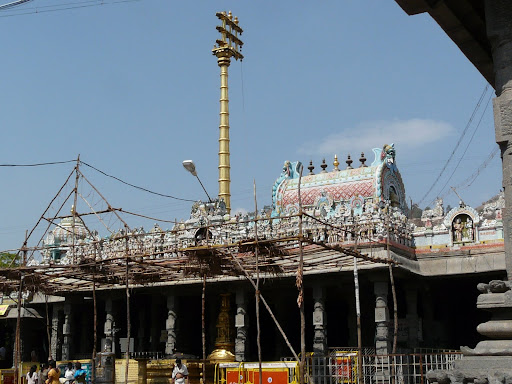
Flag Post(Kodi Maram) at Arunachalla Temple


It became quite lucid to me as I started to pen this blog that the intention behind creating festivals and prayers to constantly engage the mind on God was an extraordinary and  successful concept. I cannot speak for other countries and towns but can proudly proclaim that Tongaat has kept the Hindu torch ablaze despite the tumultuous history and religious and cultural isolation from India for many decades.
It portrays an essentially unique Hindu characteristic where at regular intervals, the town sprouts with excitement and colour over an impending festival. I must add they are quite strategically positioned to ensure that the devotee is never robbed of his dose of spiritual inspiration throughout the year. Even in the midst of the seasoned holidays like Easter and Christmas,  temptations fail to lure the 'bhaktas' from chanting the Lords name.


I recall vividly growing up in one of the Tongaat Sugar Housing schemes,  how households would be abuzz with excitement and preparations awaiting the arrival of the Lord mounted on his gloriously decorated chariot, parching the thirst of his devotees with his enchanting 'dharshan'. Seasons and landscapes may change but I remain confident that these wonderful  traditions will continue to add flavour to our lives till our last breaths.


Yesterday, two of our sister organisations, the Isinembe Shree Veeraboga Emperumal Temple and the Chinna Thirupathi Venketeshawara Devastanam held their annual chariot festivals. A colourful display of devotion that contagiously spreads a warm and inspired feeling amongst people,  having spent the entire day singing and chanting God's sweet name.


A dear friend was chatting to me after the proceedings of the prayer and asked a very interesting question. “When will people learn to elevate themselves, they come sing songs eat and go home.” A very interesting observation I thought as it quintessentially speaks to the perennial despondency, pain and suffering experienced by many. We are often so quick to point fingers at God, but have we sat and analysed what we have done to change the status quo of our lives.


Sri Ramakrishna said: “The wind of God’s grace is incessantly blowing. Lazy sailors on the sea of life do not take advantage of it. But the active and strong always keep the sails of their minds unfurled to catch the favourable wind and thus reach their destination very soon”.


The inaugural celebrations of the chariot festivities commence with a very significant practice which is pregnant with a philosophy of self evolution. The prayers involve the raising of the flag on the flag staff which is located in front the main entrance of the temple. The presiding deity of all flag poles is an animal which is the 'vaganam' (carrier) of the presiding deity of that temple. In this case it is 'Garuda', the celestial bird who is the official transporter of Maha Vishnu. Temple architectural design is governed by the scriptures which dictate that the eyes of the Garuda murthi must be in line with the feet of the Installed murthi in the inner sanctum. Above this main murthi is the dome of the temple which culminates with a gold or metal 'Kalsum'. The top of the flag post must be in line with the 'kalsum' on the dome.


Most of us although given a very important and divine gift of 'Viveka' (discrimination and intellect) in this human birth, live our lives like animals who are slaves to their senses. Animals operate purely by instinct and sense stimulation. As Paramahamsa Yoganandaji said: ”We live like sudras who see no greater purpose than the satisfaction of wants and desires of the body. Such persons eat, sleep, work , multiply and finally die.” Such an existence is plagued with despondency, unhappiness, troubles, irritation and anxiety. This mechanical way of living and even mechanical way of attending prayers and functions does nothing to release you from the fetters of this chronic misery.


Then it is understandable why most prayers or festivals at the temple commence with the flag hoisting ceremony, indicative of the first step we should all practice if we want to experience perennial joy alone. That is, to raise our consciousness from the base animal and body conscious level to the divine spiritual level - as one would see the 'garuda' on the flag is raised from the bottom to the height of the 'kalsam' on the dome. Forget that you are this body, and forget about the existence you lead, think you are divine, that very Lord that pervades this universe is in you.  And as the singing and activities go on in the temple take some time to delve inward to commune with this Lord that is within you. Start to remove the layers of ignorance and negativity from your minds activity. Use the bhajans and worship that is being done as detergents to clean the mirror of your mind. Let it shine and reflect all the positive energies inside so you can see that he who is the universe himself dwells in you as the atman. Raise that energy from down below to the topmost part of your head which will unlock the treasure of eternal bliss that you are.


Essentially that’s what beloved Swami Vivekananda speaks of when he said "Arise, Awake, stop not until the goal is reached". Raise your consciousness to that divine level. Take note though this does not come easily. One must be sincere and have steadfast devotion and faith in God. It is through His grace alone that the lubrication is provided to ease the friction of spiritual elevation.

May your journey to divinity be blessed by His grace is my sincere prayer.


With love always.

Sunday, 2 October 2011

Shubh Navarathri

Aum Namo Narayanaya


|| Sri Ramakrishna Sharanam||                               

In a special hymn to the Divine Mother, Shri Shankarcharya said, Jagadambe vichitramantra kim paripurna karunasti cenmayi aparadhaparamparavrtm nahi mata samupekshate sutam.
“O mother of the Universe, there is nothing to be wondered at if thou should’st be full of compassion for me. For a mother does not forsake her son even if he has numerable faults”.

As aspirants are on a quest to unravel the mysteries of the universe and cajole their interpretations within the framework of science, their task becomes unattainable as the grace of God continues to mesmerise the most lettered through the process of creation, sustenance and dissolution. This concept eloquently described as Siristi, Sthiti and Vinashnam in the Devi Mahatmayam.


Mother Universal Kali

But Master Sri Ramakrishna explained in the Gospel of Sri Ramakrishna:

What is the need to know the amount of branches or leaves on a tree when you have come to the orchid to eat mangos. Will our finite mind and intellectual capacity be able to understand this great maya of the perceived world.

It is good enough for us just to have love, devotion and faith in God and according to our nature we will perceive the divine. Although many religions are quite patriarchal in their approach, Hindu Dharma is essentially liberal - allowing the devotee or aspirant the opportunity to approach God in his most comfortable form with the underlying basis that God is one.

It is no wonder then that hundreds of thousands of people throughout the world have taken the Divine Mother as their ishta (personal God). In the two branches of thought, ie. monism and dualistic - one can see God as another or one can understand that God and the self are one. In the dualistic approach which forms the underlying foundation of bhakti, a very special relationship is developed with the ishta.

While growing up we can all give beautiful accounts of the special bond and relationship that we have developed with our mothers. A mother is the reservoir of love and compassion irrespective of your character and appearance. She no doubt is the embodiment of selfless sacrifice. Mothers have lost countless hours of sleep nursing her sick child, worked extreme hours to feed and clothe her children - knowning well one day they will leave her.

Such love is beyond words. If such love is possible by imperfect human beings can you ever image what is possible by the eternal Divine mother of the Universe?  The unconditional, unrestricted river of love that embraces every part of creation is the tonic that can cure the maladies that afflict this world.
But what is the secret to get the attention of our Mother universal? There is no other life documented that has portrayed the most beautiful relationship between a mother and son than that between Sri Ramakrishna and the Divine Mother.

His life demonstrates how the intense yearning and crying for the vision of the Divine Mother culminated in the most divine experience and vision which set out to change the entire course of his life from a mad God man(as called by many in Kolkata ) to Paramahamsa. This episode clearly gives credence to and augments the thoughts of many sages and saints that God does not come to one through elaborate book knowledge; but through intense longing and love, one can then experience God. Yes, God has to be experienced not read about.

When a child is occupied with his toy in a cot, the mother is quite content with her activities and is satisfied that the child is not in need of her. But at the instant that the child starts to cry or scream the mother will immediately drop whatever she is doing to attend to the child. This is the secret to get the attention of the Divine Mother as well, said Master.

We are so intently enjoying the comforts of this world that we have not sent even a glance of a thought towards the Mother. Although She is mindful of us, She will only come to us when we call. Can the toys of the world ever equate to the loving embrace of our mother? Can all the cuisine of the world give nourishment to our soul?

As Her children we undergo many challenges in this world. They can be very overwhelming and stubborn at times. We need not undertake these challenges alone though - like how she took us to school on our first day, or saw our first dance recital or sat with us through our matric exams - in life too we can seek the comfort of our mother universal.

As Durga, She is the fort of our lives, ready to protect us against the challenges of life. Ma Kali is the remover of all our desires which is the biggest obstacle to our joy and happiness. Mother Lakshmi bestows prosperity both materially and spiritually upon us and gives us aim and direction in life. And finally, as Mother Saraswathi, She gives us knowledge of the world but most importantly knowledge of the self to know that we are divine children of her.

Then, why do we behave like beggars? When we want money to buy clothes, or are hungry and want food we go to our mother. Then why are we so shy to ask our mother universal that which is rightfully ours? Take this opportunity my dear brothers and sisters to reconnect with your Mother Divine… cry and intensely long for her… she will undoubtedly answer your call.

I pray sincerely that her love and grace flows abundantly upon all. I conclude with the most loving words of Mother Sarada, “Whenever you are in distress , always remember you have a Mother”.

With love and prayers always

Sunday, 25 September 2011

My Rich Heritage

|| Sri Ramakrishna Sharanam||

Our Country South Africa

Aum Namo Narayanaya
My loving pranams to you all. I trust that as South Africans we utilised Saturday (Heritage Day) to reflect upon and appreciate our heritage. As descendants of an immigrant community there is always sometimes ambiguity with regards to our identities. The cultural umbilical cord continues to nourish our love for our ancestral motherland.
At this point I recall the thunderous words of Swami Vivekanada when  he said: “What we
want are some young men who will renounce everything and sacrifice their lives for their country's sake.” For the love of His country Swamiji dedicated his life's breath for the emancipation of the masses who were displaying vivid signs of oppression and colonisation.
After spending three days and nights in deep contemplation and meditation at Kanya Kumari, Revered Swamiji proclaimed: “The best way to serve and seek God is to serve the needy, to feed the hungry, to help the fallen and friendless, irrespective of caste or creed.”
It is definitely the Dharma of an individual to give his life if need be in defending his land of birth, and to work for the welfare of all its citizens.
In terms of this duty no one has put it more eloquently than Swamiji when he said: “I hold every man a traitor who, having been educated at their expense, pays not the least heed to them! I call those men who strut about in their finery, having got all their money by grinding the poor, wretches, so long as they do not do anything for those two hundred millions who are now no better than hungry savages.”
Yes indeed, I am African and South African identify strongly with the words  of our former President Thabo Mbeki when he said:
I owe my being to the hills and the valleys, the mountains and the glades, the rivers, the deserts, the trees, the flowers, the seas and the ever-changing seasons that define the face of our native land. My body has frozen in our frosts and in our latter day snows. It has thawed in the warmth of our sunshine and melted in the heat of the midday sun. The crack and the rumble of the summer thunders, lashed by startling lightening, have been a cause both of trembling and of hope.
The fragrances of nature have been as pleasant to us as the sight of the wild blooms of the citizens of the veld. The dramatic shapes of the Drakensberg, the soil-coloured waters of the Lekoa, iGqili, noThukela, and the sands of the Kgalagadi, have all been panels of the set on the natural stage on which we act out the foolish deeds of the theatre of our day.
At times, and in fear, I have wondered whether I should concede equal citizenship of our country to the leopard and the lion, the elephant and the springbok, the hyena, the black mamba and the pestilential mosquito. A human presence among all these, a feature on the face of our native land thus defined, I know that none dare challenge me when I say - I am an African!
In saying this, I can never deny though, my lineage back to the great sages of India, who have through immense austerities and penance handed down the most profound knowledge and value systems for the welfare of humanity. I therefore feel proud and with this knowledge as the basis of my existence I am in a better position to contribute positively to my country and people.
On this important day, the Shree Veeraboga Emperumal Temple launched the Narayana Seva Grain Bank, which will provide hot meals to the hungry on a weekly basis at first and then seek to increase the frequency as the project gains momentum.
As part of this seva a wonderful addition was added to the temple, which is practiced in many Narayana temples in India. The Thullabaram (scale) where devotees make an offering equivalent to their body weight was also launched. Devotees will be able to donate grains and items equal to their body weight towards the feeding project. Without a doubt they will receive the divine grace of the Lord.
This project is not done as a mere charity but with the motive of serving the Lord in man and will lend impetus to nation building and driving the social and development agenda of our country.
I sincerely pray that we appreciate our heritage and work selflessly for the welfare of our country in all respects, whilst preserving the rich lineage of our sages and saints of India.
This week millions of Hindus throughout the world will commence the festival of Navarathri - the nine nights of worship dedicated to the Divine Mother.  The Mother in our dharma has been given the highest form of respect. She is always respected first, yes even before God - as the famous saying goes: “Mataa, Pitha, Guru, Devam” which translates to “Mother, Father, Guru and God”.
She is unmatched in compassion and love and will give her life for her children. In the same manner one’s county is one’s motherland and if one respects and reveres their country, she will reciprocate with her all embracing motherly love.
I take this opportunity is wishing all observing Navarathri the grace of the Divine Mother and may you have the opportunity to feel Her love.
With love and prayers always

Sunday, 18 September 2011

Rama Bhajanalu

|| Sri  Ramakrishna Sharanam||

Aum Namo Narayanaya

Let me start this blog by wishing all those observing Purutassi and Pitr Paksh a very rewarding and divine experience. I am sure that the tone and bhav has been set to experience the grace and love of the divine during this period.

Sri Sita Ramachandra Lakshmana and Hanumanji

The month started with much impetus at the Shree Veeraboga Emperumal Temple when we hosted the annual Raam Bhajanalu Festival at the temple yesterday. A huge crowd gathered, although it was the final day to indulge in feasting before the month long fast.
As I witnessed the Bhajan, it occurred to me how great the force of God was that it broke down barriers that have been established by man. I speak of the language and cultural partitions that have wedged us. It was inspiring to see how Tamil speaking youngsters sang and performed this Telegu  folk art of Andhra Pradesh with relative ease.
I am not an expert on Andhra culture, and was indeed appreciative of the erudite article researched and presented by Dr Pravine Naidoo (Attorney of the High Court of SA) on the origins of the Raam Bhajanalu. With his kind permission I have reproduced it here for you to enrich your knowledge on the subject.
 
 Article begins

Raama Bhajanalu is one of the most popular folk arts, and has for centuries been a vehicle of self-expression and fulfills the needs of the spiritual-minded Telugu rural folk of the Andhra Pradesh State in South India.
Raama Bhajana / Chekka Bhajana is a form of dance accompanied by the striking of cymbals as well as striking of wooden pieces of one or half feet long and about 3 inch wide to the ends of which two round brass or iron pieces are fixed. Bells are placed in the center by making holes. They are held against each other in between the palm. The jingling music produced when the palm is opened and closed, along with the song is very pleasing to hear to which the dancers dance. Chirata is a smaller instrument, which is 8 inch to 9 inch long and 1 inch to 1 1/2 inch wide.

They are used especially to sing songs in praise of Lord Rama and the performance is known as Rama Bhajana and the performers ‘Rama Dandu’.  In the 'old' days each village had a trained group (dandu) of Raama Bhajana / Chekka Bhajana dancers, who used to move with two (02) kola lamps/torches and an idol of Lord Rama from one village to the other. Villagers used to learn it during the lean months of summer, when they are relatively free from agriculture work. It is obligatory to the Rama-Dandu of the next village to receive the bhajana troupe and the idol and take it to the next village. Ultimately, after touring several villages on the way, the troupes reach Bhadrachalam on the Rama Navami day and pay their homage to Lord Raama.
There are innumerable troupes all over Andhra Pradesh, which perform the Raama Bhajana / Chekka Bhajana even today. They are however limited to their villages, mostly in North Eastern Coastal Andhra Pradesh (Vishakhapatnam, Vijayanagaram, Srikakulam Districts).

The Raama Bhajana / Chekka Bhajana group consists of about 16 to 20 artists. The artists are dressed in simple, yet, colorful costumes - a dhoti, a waistcloth, a colored kerchief around the neck, a garland, flower bracelets on the hands, ankle bells and a smear of vermilion on the forehead. Each dancer carries his "chekkas" with much adoration.

The performance contains several Telugu songs to varying rhythms called ‘kopus’. There are about 100 Kopus or adugulu in which a particular song is sung. Every song contains several kopus, based on the variations.  In this performance, there is a main singer who initiates each song and sings a line, which is repeated by the others. The commencing steps are known as Adi Adugu (beginning steps). This is compulsory item. The other steps are known as Potu Adugu, Kuppadugu, Kulukula Adugu, Joku Adugu, Nemili Adugu, Gurappu Adugu, Uyyala Adugu.

Most of the Telugu bhajana are dedicated to Lord Raama, Lord Narayana (Maha Vishnu / Venkateshwara), Narasimha Deva Swami & Simhadri Appana Swami.  With its great variety, innate devotion and an element of drama, Raama Bhajana / Chekka Bhajana is the most popular form of narrative art in Andhra Pradesh.
It is a matter of immense pride that the descendants of those Andhra-Telugu forebears in Andhra Pradesh are still propagating, preserving and advancing their rich linguistic, religious and cultural traditions in South Africa to date.

 Article Ends

We understand that we must internalise these practices for our spiritual growth. I recall in one discourse revered Swamiji Vimokshananda spoke of “su” meaning to be in tune. This Bhajan is sincerely appreciated when the singing, dancing, cymbal and drum playing are in sync. If not, it would present as a huge irritation. In the same way we must synchronise our mind, word, thoughts and actions with our spiritual consciousness.
Then we will be well constituted to radiate the divinity that is latent within each of us.

Those whose faculties are not in tune with the divine consciousness can be referred to as 'asuric', a word we all would have come across in many of our puranas.

Let us all resolve during this auspicious period to make constructive changes in to our lives to navigate towards divinity. Take the name of God, apply it to our physical being, mental being and spiritual being and slowly all our asuric qualities will fade away. 

Till next week, may you enjoy a blessed week.
With love and prayers always.

Sunday, 11 September 2011

Purutassi - A Month of Spirtual Elevation

||Shri Ramakrishna Sharanam||                               

Aum Namo Narayanaya

Thirupathi Balaji
The month of September not only heralds the season of Spring and rejuvenation but signals the time to spring-clean mind and body and set upon austerities for one's spiritual progress. Yes indeed, I speak of the month long fast in which predominantly South Indians will undertake. With just about a week to go before this auspicious month begins, many households would have commenced their annual cleanup in preparation for the significant period which is associated with cleanliness, purity and devotion.

This prayer is associated with Lord Venketeshwara or Emperumal as he is affectionately known in many quarters. It is known that worship of Narayana comes with immense sacrifice, austerity and purity in all fronts. Worship to Him in this month is concentrated on Saturdays (regarded as His special day) with preparation of simple vegetarian dishes or simply fruit and milk. Special hymns are recited followed by chants of “Govinda Govinda” - sending immense energy and positive vibrations into the air, and churning the minds and hearts of all with His sweet name (meaning 'the protector of all').

Although many have associated this month with the harvest and monsoons in India, we have come to learn that all rituals and prayers in Hindu Dharma have been introduced deliberately to  invoke introspection and divine feelings on the highway  to self realisation or God realisation. If these were not introduced at periodic intervals, then man would continue his mundane existence and only turn to God when in trouble. It is possible for us to lead a life of constant bliss if we are in regular communion with God.

Fasting is generally associated with a total abstinence of any food for a particular period.  Although many devotees undertake a fast on the Saturdays on which worship is offered, the month is usually observed with the abstinence of meat, alcohol and sense pleasures as a means of purifying the physical being. The term that would be most appropriate to this month is Upavasa. Vasa means to reside and Upa means near.

This month is therefore an attempt through certain austerities and sacrifices to reside close to God. Lord Venketeshewara who resides on the seven hills of Thirupathi is referred to as the Lord who burns all sins (Ven – sins, keta - burn, eshwara – God). The temple of the Lord whose dome is adorned in pure gold is situated on the top of the seven hills. The seven hills represent the seven deadly desires that prevent us from reaching the house of God. They are lust, greed, gluttony, anger, hatred, dishonesty and ego or pride. When one starts on the pilgrimage from Thirupathi to Thirumala on foot, one understands the journey of life more easily. Along the way you will pass the various temples dedicated to the various forms or avatars of Lord Narayana indicating and directing us to evolve from the baser level to our true nature of divinity.

Sri Ramakrishna says "Desires are like holes in a vessel. We can work extremely hard to fill the vessel but all the contents will leak out."
 
 In the same way, all penance and spiritual efforts are leaked through the holes of desire. If we are able to overcome the seven deadly desires in life we can find that Lord that we all seek - like finding the glorious golden abode at the end of the seven hills of Thirumala. The Thirumala that we all want is in our hearts. By cleaning our external through the observance of fasts we strengthen the will and mind to transcend the desires which cloud the divinity within.  Replacing all these desires with pure devotion and love for God will allow to be close to him. Srinivasa which is another name for Venketeshwara means the Mother Luxmi who resides in the Lord. In the same way, if we purify both our external and internal being then the Lord will reside in our hearts. We will thus be in constant communion with him ensuring we are bathed in His complete mercy and bliss always.
 
The Shree VeeraBoga Emperumal Temple will be commencing the month of Purtassi with a special Raam Bhajan on 17th September 2011 commencing at 17:30pm. Thereafter, the first week will be celebrated on 24th September 2011 commencing at 16:00pm. This will continue every Saturday thereafter culminating on the last Saturday 15th October 2011 with the reading of the Veeraboga Sarithram. Supper will be served and all are welcome. I take this opportunity in wishing all those who are observing this auspicious month, the grace of Lord Narayana.

With Love and Prayers Always

Sunday, 4 September 2011

Swami Vivekananda for World President


|| Sri Ramakrishna Sharanam||

We have entered the season of rejuvenation and growth. Already signs of life have emerged unscathered from the clasps of the barren slumber. An impetus for activity has caught on and there seems to be no chance of abating the spirit as a flurry of colour twinned with a metamorphosis in fashion taking centre stage.

Swami Vivekananda

Concurrently with natures resurgence we are spectators to a phenomenal resurgence or activism that has captivated the globe at various points. What started in Egypt has sparked a wave and series of mass mobilising against regimes that have failed to meet the demands of the people. These unchecked volcanoes of discontent, frustration and social injustice can no longer hold its contents of fury.
South Africa is also not immune to this volcanoe as hundreds of disenfranchised youth threw their weight behind their youth leader for his vociferous call for policy change in land redistribution and mine management in our country. This will continue to be a regular occurrence until the capital elites stop self enriching and send their thoughts towards the masses in poverty.
Swami Vivekananda said,” my whole ambition in life is to set in motion machinery which will bring noble ideas to the door of every day. Work hard, be steady and have faith in the Lord, elevation of the masses without injuring their religion. Remember that the nation lives in the cottage and nobody ever did anything for them. Can you raise them (the masses) can you give them back their lost individuality without losing their innate spiritual nature?  Can you become an occidental of occidentals in your spirit of equality, freedom, work and energy and at the same time a Hindu to the very backbone in religious and cultural instincts? This is to be done and we will do it, we are all born to do it. Have faith in yourselves, great conviction is the mother of all great deeds.

Swamji was a strong advocate and champion of the poor masses and lobbied to improve their condition. The teachings of Swamiji placed emphasis on man making education to augment the social values and moral fabric of society as expounded by the ethical ideology of Vedanta.
Swamiji a monk of the Ramakrishna Mission and Math was way ahead of his time in terms of the trajectory that India must take in order to raise from the ashes of exploitation and colonialism which left her destitute. Being a monk Swamiji has thought us that detachment does not mean aversion. Sri Ramakrishna also pointed out that there is nothing wrong with making money so long as it is utilised for the goal of god realisation.
In this material age money is an essential component to satisfy the basic needs of the body, without which the higher goals of spiritual advancement become attenuated.

Swamiji

Swamiji’s travels to the West and Asia made a tremendous impact on his vision to raise India, his focus was to take up industrialization to move the economy. He said,” if I can get some unmarried graduates, I may try and make arrangements to send them to Japan to get some technical education there. So when they come back they can turn their knowledge to the best account for India. The secret to Japans success is that they have taken the knowhow from Europe but remain Japanese, whilst in our country the mania of Westernism has gripped us like the plague. Due to this westernisation agriculture which is an important economic driver had taken a back seat.  Government policies and leaders have failed to stimulate these sectors of the economy by easing access to capital finance and subsiding agriculture yet support and nurture selfish capitalists.
The question that claims our attention then, we live in a world with so much knowledge, resources and science why can’t we rid the world of poverty and starvation? The answer is simple, greed which leads to corruption results in non delivery of services and assistance to the citizens. This is not new and has been happening from more than 3000 years. Evidence of which can be found in our scriptures. This has prompted great minds of the times to give guidance on this malaise.  When one reads the Arthashastra of Vishnu Gupta or Kauthilya , one can see the guidelines in running an ideal state that will ensure good governance for the welfare of the masses of people.
The way forward for leaders and policy makers is to latch onto Swamijis ideas on poverty eradication. We should and must take his vedantic approach, “Look upon every man and woman as God alone. You cannot help anyone; you can only serve the children of God. If the Lord grants that you can help anyone one of his children, blessed are you. Do not think much of yourself. Blessed you are that the privilege was given to you when others have it not. Do it only has worship. I should see God in the poor, and it is for my salvation that I go and worship them.
What a profound philosophy Swamiji has given us, which when practiced with sincere devotion will instil within each one of us an expansive heart which will see the divinity in everyone irrespective of their circumstances and at once without hesitation make us serve them as the very father who created this universe. Where in there will we find the room for arrogance, greed and selfishness?
Let us as Swamiji said, accumulate “power “in silence and become dynamos of spirituality.
Viva Swamiji Viva !!!!! 

Sunday, 28 August 2011

Ganesha My Sweet Lord


Lord Ganesha

|| Sri Ramakrishna Sharanam||

In attempting to write this blog on this very interesting topic my thoughts nostalgically find itself in Chennai three years ago. Amidst the beating sounds of the tuk-tuk (mini taxis in India) and the annoying  intrusions of the multiple horns blaring for attention, my senses wafted towards the soothing incense that permeated the air from down below. And suddenly everything was interrupted by about three or four significant thuds to the ground.
I immediately made my way to the window of my hotel room to find a sizeable gathering around a dainty shrine which housed a deity of Lord Ganesha. The thuds originated from the coconuts that were slammed against the stoney and broken asphalted surface. Rather mechanically, everybody started tapping the side of their heads with a clinched fist as the priest broke the silence with the harmonious ringing of the bell and the melodious rendition of Aum Suklambaradarham Vishnum.
Aum
Shuklambaradharam Vishnum
Shashivarnam Chaturbhujam
Prasannavadanam Dhyaayeth
Sarvavighnopashantaye


Suklambaradaram - one who wears a white garment
Visnum - all pervading
Sasivarnam - one who has a brilliant complexion (like the full moon)
Chaturbhujam - one who has four hands
Prasannavadanam - one who has an ever smiling and benevolent face
dhyayet - I meditate upon
Sarvavighnopashantaye- for the removal of all obstacles

It is no wonder then, that those who pass this shrine on their way to whatever activity they are going to engage in to offer their pranams and love to that Lord who has the ability to remove all obstacles. In South India Lord Ganesha is commonly refered to as Pillayar and eulogized as Mudalvana (one who is first worshipped).
Shrines like the one outside my hotel are very common in every village, town and city in India. You will be fooling yourself if you think that you can travel more than 100m without embracing some form of Ganesha. The iconography of this most unusual yet magnetic form of the divine finds itself on shop signage, doorways, car dashboards, wedding cards, temple architecture, shrines and many unthought-of places.
It is through the obsession of man to have a life free of challenges and obstacles that Lord Ganesha is propitiated throughout the length and breadth of the world, not only by Hindus but other religious denominations as well.
There is no prayer, function or activity amongst most Hindus that will take place without first offering their pranams to Ganesha to ensure that whatever obstacles that may obstruct that activity about to be undertaken should be removed.
However I am reminded that last year during the Ganesha Chaturthi celebrations, revered Maharaj Swami Vimokshananda in his discourse mentioned that although worshipped for His grace in removing all obstacles, He is also known for placing obstacles in the path of devotees. The dichotomy of benevolence and malevolence surely arises from His mercy to help His devotees discriminate between their needs and desires.
We must not forget our role and purpose of god realisation - to search for that divinity that is within each and everyone of us. Often enough we are gripped with chronic materialism and focus our attention and resources in that direction. It is then that the Lord will place obstacles to dissuade you from going down the wrong path for your own good and protection.
 

Lord Vinayaga

We are all in search of joy and bliss. But along the journey in this material plane we enjoy just temporary jolts of joy interrupted ever so much by pain and despondency.  I refer back to Maharaj's discourse when He said that Lord Ganesha’s favorite food is the Modaka or Modagam as pronounced in Tamil - a sweet dumpling prepared by the millions to be offered to the Lord as his most preferred dish on his special day.
This Modaka (Moda means joy) is what we all desire at every moment in our life’s journey. The bliss that we seek is possible if we follow some simple rules as displayed through the form of Ganesha.
The large ears and small mouth asks us to speak little and listen more, the small eyes are personification of concentration. The axe dictates we should chop away at the bonds of attachment , the one broken tusk to suggest that we keep the good and get rid of the bad and the small mouse (representing desires) as his vehicle is most significant as it strongly implies that we must bring our desires under control. Bring our desires under control makes way for a clean clear mind which will act as a mirror and reflect the divinity that is within you.  You can thus enjoy the Modagam of divine bliss.
The other form that Vinayagar is worshipped as is Aumkar or Aum. Aum is said to be the sound with which the entire creation resonates in. It is the frequency at which divinity is spread and permeates the universe. So if we want to attract divinity and the prosperity of the Universe it is wise that we modulate on this frequency of Aum rather than challenge or oppose it.

It is on this note that i would like to sign off this blog and invoke Lord Vinayagar in prayer for the welfare of all in this creation. May he preside over your life so you may obtain the modaka of immortality is my sincere prayer.
With Love and Prayers always
Aum Gam Ganapataye Namah